
A research-through-design exploration into how designed interventions can nurture authentic connections between people in everyday contexts.
↗ You can read the full design rationale here (I promise, it's a fun read!).
Project duration 3–4 months
Skills & methods Contextual inquiry & interviews / Participatory design / Experience mapping / Prototyping (low to high fidelity) / Behavioural observation / Autoethnographic research / Workshop facilitation / User testing & iteration / Visual design & communication / Persona creation / Journey and user flow mapping
Key roles Interaction designer / Service designer / UX researcher / Visual designer / UX/UI designer
Tools used Adobe Illustrator / Journaling / FigJam / Figma / Adobe InDesign / Adobe Photoshop / CapCut / Paper prototyping

Project Overview
This thesis project looks at how design could facilitate meaningful social connection in everyday life. Through an iterative, research-through-design approach, I tested a series of interventions in different contexts, from shared public spaces to people's everyday spaces, to understand how people connect, communicate, and form more genuine, authentic bonds. The outcome is the result of not a single product, but a set of insights, artefacts, and reflections that reveal how small design decisions can shape our sense of belonging and facilitate more meaningful interactions.
Research & Context
I began by questioning how people experience connection in an increasingly virtualised world. Through literature, interviews, and ethnographic observation, I mapped key emotional and behavioural patterns around human connection, such as vulnerability, comfort in shared silence, and the role of environments in shaping interactions. I started by asking three key questions to understand how people want to socialise, where they feel most social, and what makes connections more meaningful.


Where do people spend most time socially?
I initially asked this question in my surveys and later posed it as a probe at a public exhibition. The probe was a flat board which allowed people to place a sticker against the spaces that they felt they spent most time socially. People were invited to engage with it, and I observed how it led to discussions as people pondered where they actually did end up spending their time.


The majority of people said they spend time socially in places that they frequent as part of their routine, such as work, college or home. This shows that socialising is something that occurs as part of and in spaces of their usual, comfortable routines.
How do people want to socialise?
I asked this question, initially in my surveys and when I interviewed people, to better understand what forms of socialising really help them form better connections. It was also to understand their barriers, frustrations and desires around forming social connections.


“Possibly a fun game or event of sorts where like-minded people can come together.”
– Female, 25 / student / resides in a city
“Talking to someone not surrounded by technology”
– Male, 30 / working / resides in a city
What makes a connection meaningful?
This question helped me understand what really makes people click with one another. What turns that moment of interaction into something deeper, wherein they feel more connected to the person? Since the brief was so broad, I was also trying to narrow it down through my findings and identify those areas for design opportunities. I wanted to focus on deepening connections and the formation of more intentional social bonds rather than incidental ones.

In my survey, one of the questions I asked respondents was to list three words they would use to describe what social connection means to them. The responses were lovely, and in my synthesis, I categorised the words based on certain themes that I felt ran across the varied answers.

A comprehensive list of the responses and their categorisation

These were the most commonly recurring words
Research-through-Design Journey
I began my research-through-design process, testing and evaluating different design interventions within different contexts based on users' responses, i.e., in workspaces, apartment/residential communities, and college campuses. This testing method of trying different solutions and seeing their impact is what led me to my final discovery and outcome.
Intervention #01 The City Soundtrack
The City Soundtrack was a playful city-wide experiment exploring how music and shared creation might spark connection. Mascot stickers with QR codes appeared in everyday spots like pubs, cafés, campuses, and workplaces, inviting people to add a song to a shared playlist. This low-barrier format offered a small moment of creative contribution, without the pressure of direct interaction. As the playlist grew, it became a collective soundscape, a quiet expression of togetherness. The project asked: Who else added this track? What does this playlist say about this place, or this moment?




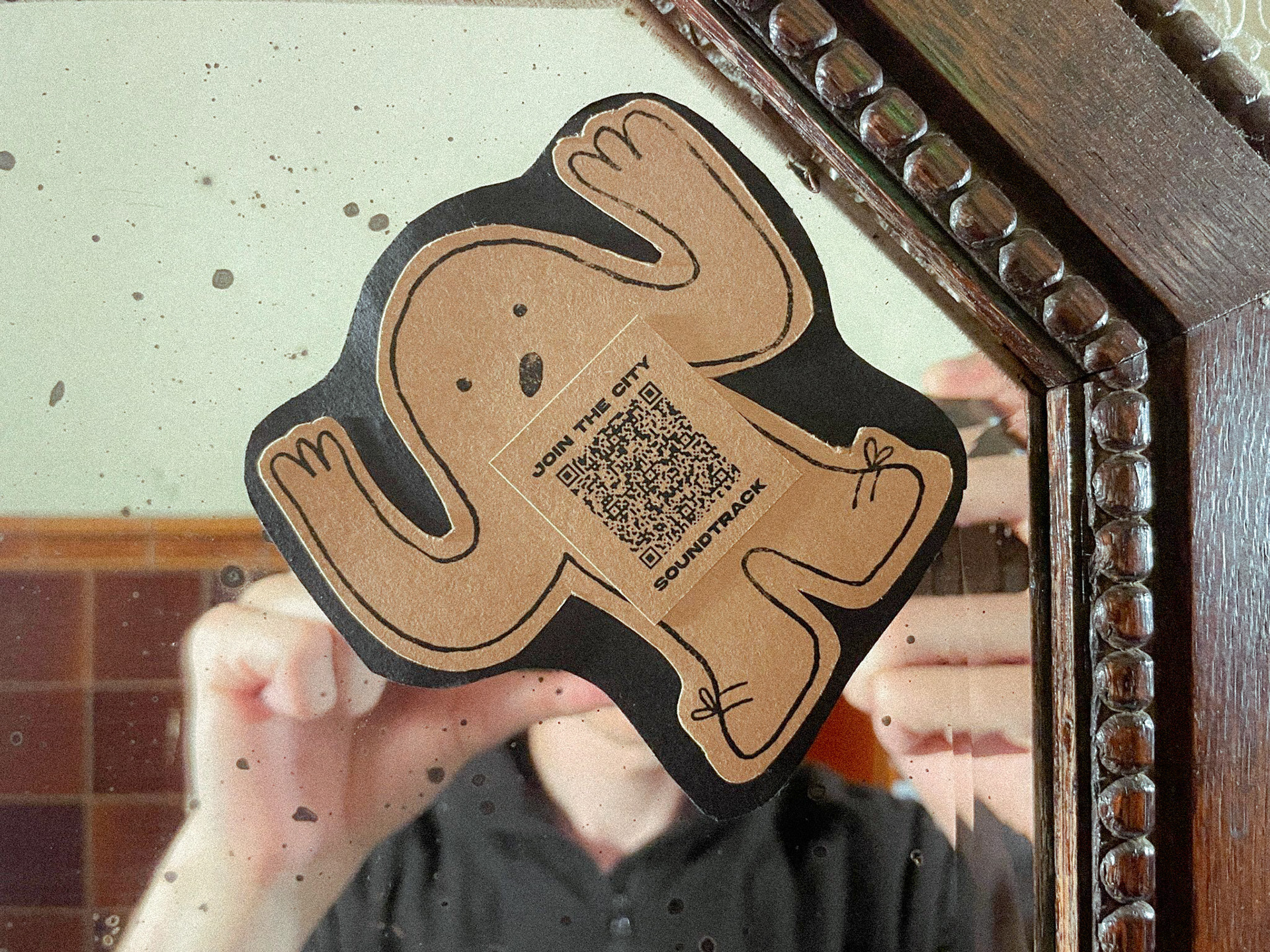


I made a set of playlists for different spaces as well


Intervention #02 The Social Log Book
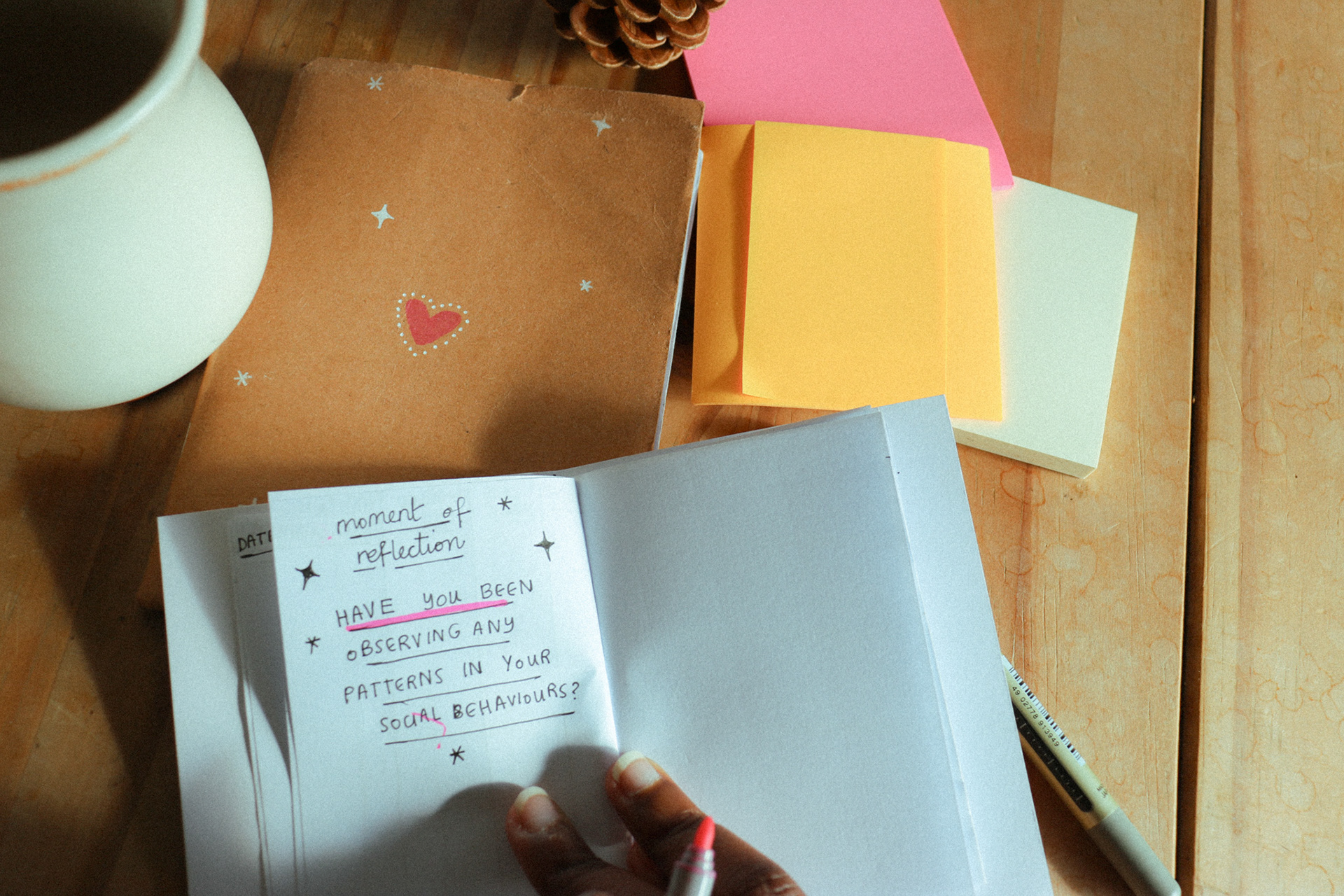
The Social Log Book grew from my own autoethnographic research. I began by keeping a personal social log and wondered if this simple act could help others build stronger connections. The Log Book is a manual notebook placed in everyday shared spaces like lobbies, canteens, and lifts, where people naturally pass by. Its visibility makes it easy to join in. Inside, clear prompts invite users to tally and reflect on daily interactions, from a shared smile to a longer chat.
Over time, the log becomes a gentle tool for self-awareness: How do I connect with others? When do I feel most open or withdrawn? Through small, regular entries, it encouraged reflection and intentionality, helping people notice the quiet habits that shape community life.



Intervention #03 The Hyperlocal Newspaper
The Hyperlocal Newspaper is a locally-driven newsletter designed by people for people within spaces like colleges, workplaces or apartments. Posters were placed around the building to invite submissions, spark curiosity and increase involvement.
A launch edition was the starting point of the intervention, which offered a friendly guide on how to contribute, helping first-time creators feel at ease. Using a simple online form, residents could submit anything from jokes and classifieds to recommendations, games, articles, or notices, whatever they feel is best suited to their community. The idea was to provide an email for questions or support, a customisable Figma template and a set of community guidelines, inspired by the USE-IT maps model of local co-creation. This intervention aimed to encourage people to take ownership of strengthening community ties through their own shared publication.


Before testing the intervention, I ran a short co-design workshop with three students to explore their views on the concept and the types of content that might suit it. Each student was given a blank version of the newspaper and asked to imagine and design the content they would like to see included if it appeared in a particular setting, i.e., a workspace, a college campus, or their apartment residence (pictured above).


Intervention #04 The Digital Communities
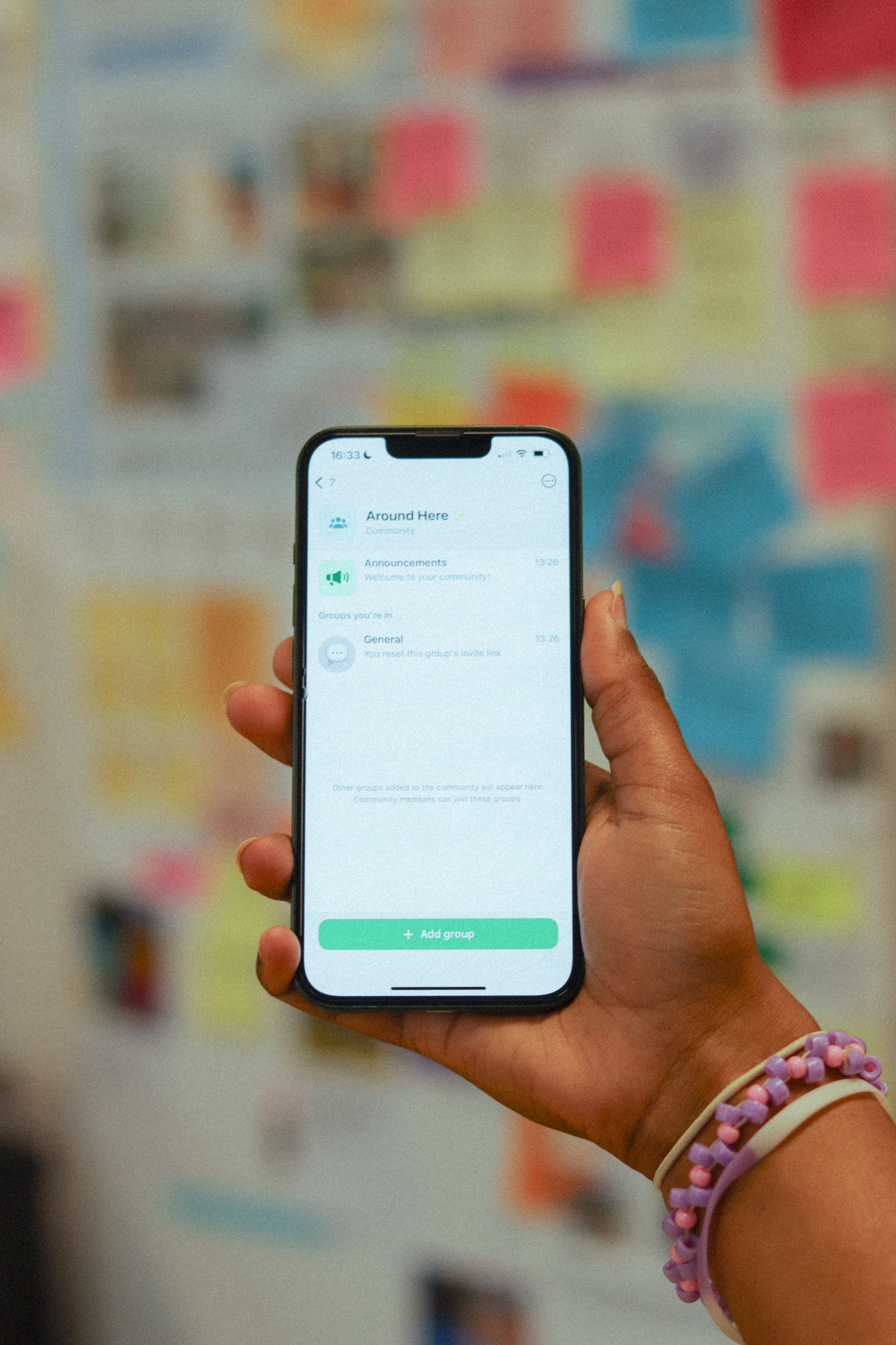
The WhatsApp Community Group is a digital layer added to everyday neighbourly life, designed to help residents feel more connected. Posters and mascot stickers placed around apartment buildings, along with a QR code in the first edition of the community newspaper, invite neighbours to join. Once in, residents can access both a general chat and create interest-based groups, all housed within a single WhatsApp Community dedicated to their apartment building. Using a familiar and flexible platform, it lets people join in when they like, start their own micro-communities, or simply what they can engage in with their neighbours. The WhatsApp group does not try to replace real connections, rather nudging them towards in-person interactions like meeting for walks, sharing recommendations or simply saying hello in the lift. In doing so, it creates a low-pressure bridge, helping neighbours move from passive proximity to an active community.


Every intervention was a way for me to understand how to improve upon it, and design an outcome that would be able to facilitate deep connections. The idea was to position these interventions, see how people responded/reacted and then develop those ideas. After intervention 4, I began to feel disheartened. I was really hoping that the newspaper would be successful and people would submit stories, share anecdotes through this medium.
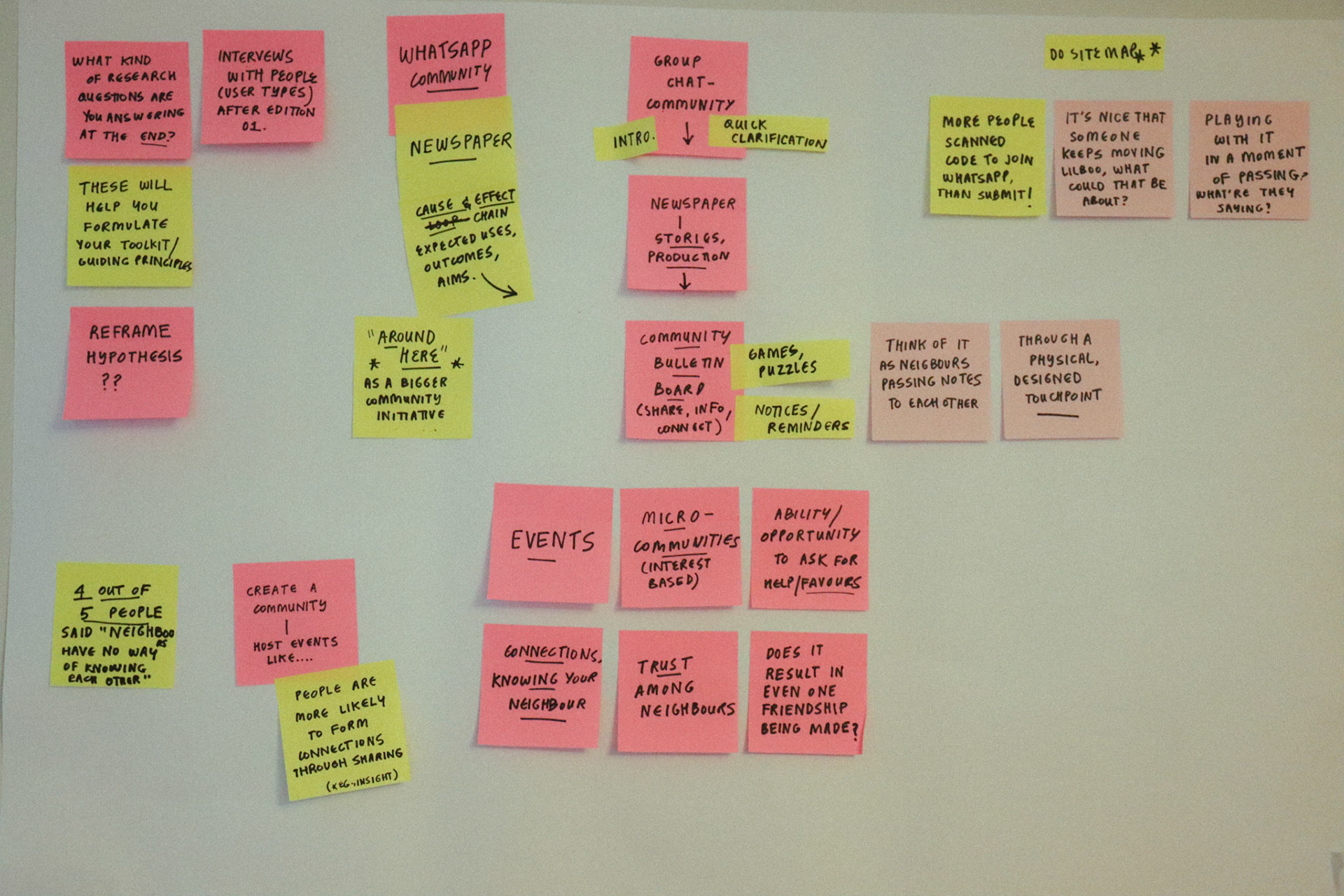
However, when I didn't get the responses I hoped for, I went back to the drawing board and started to jot down all the thoughts in my head. By doing this, I was led to my final intervention.
Intervention #05 The Neighbour Notes Board
The ‘Neighbour Notes’ Board is a simple, physical touchpoint designed to encourage neighbourly connection in a low-pressure, asynchronous way. A cardboard grid, marked with apartment numbers, is positioned in shared spaces like lobbies, entrances, and possibly in lifts of the apartment building. I invited residents to leave casual notes in their corresponding apartment cell. Whether it’s “I’ve cooked extra dinner, does anyone want some?” or “Looking for a pet-sitter this weekend”, the format creates opportunities for small favours, shared resources, and everyday kindness. With no need for direct or real-time interaction, it gives people the choice to engage when and how they’d like. The aim was to build familiarity and trust gradually, through small gestures which could result in more face-to-face moments. The bulletin acts as a visible reminder that you’re surrounded by potential connections, and enables playful, low-barrier ways to reach out. It’s more about quiet invitations to be part of each other’s daily lives.
Building & Setting up the Neighbour Notes Board


Testing the Neighbour Notes Board

Once I had positioned the board within the apartment, it was so exciting to see the residents leaving different notes

Insights Drawn from my Research-through-Design Journey
• Low-barrier means higher engagement
• Playfulness sparks curiosity
• Familiar platforms work best
• Trust builds over time through interaction
• Apartment residents have the most desire to deepen connections

THE DESIGN SOLUTION
Around Here', A Hybrid Toolkit for Apartment Residents to Build Stronger Connections & Communities
Around Here', A Hybrid Toolkit for Apartment Residents to Build Stronger Connections & Communities
Based on these insights, it became clear that apartments offered a strong opportunity for design intervention. Many of my tests showed residents not only felt excited but had a real desire to know their neighbours better. Alongside this need for connection, one interview quote stood out:
“It’s about people trying to bring people together.”
– Rachel (Accenture the Dock) on what truly makes connections meaningful
I began to see how collaboration and creation, when encouraged, could bridge towards deeper connections. This led to the design of a playful toolkit that would empower residents to build their own interventions, thus helping them form deeper bonds and stronger communities.
Design Language of the Toolkit

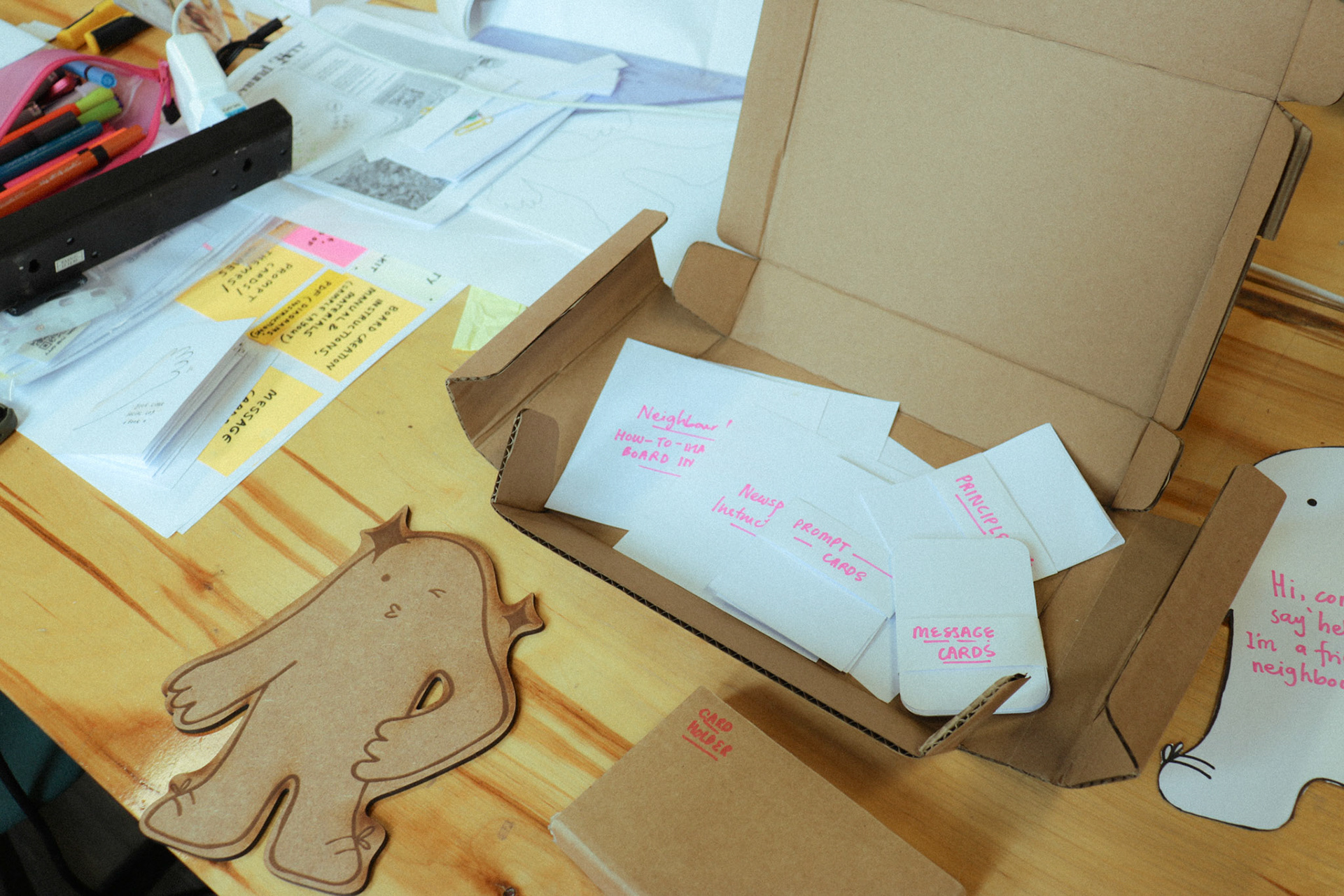
Building the Physical Toolkit
PHYSICAL TOOLKIT: PROTOTYPE 01

PHYSICAL TOOLKIT: PROTOTYPE 2


PHYSICAL TOOLKIT: FINAL PROTOTYPE + COMPONENTS


Building the Digital Toolkit
It was a very thorough and extensive process to build the digital version of the toolkit as it had to be as accessible and easy for residents to use as possible. This required mapping out the different components that would be available digitally, curating the tools that would be used to offer these toolkits.
Residents needed to be able to build these interventions in the clearest, simplest manner. As the designer, it was my duty to make this possible through easy-to-navigate platforms, straightforward guidelines and maintain a sense of playfulness and vibrancy.


Final Prototype: 'Around Here' Website
Sketchbook
I maintained a sketchbook throughout the duration of the project to help me keep track of my observations, insights and to help me stay inspired. I love journaling and believe it adds so much value to the ideation process so maintaining this sketchbook was a crucial part of my process.
Watch the fun little video I made as an explainer and promo for the concept of 'Around Here' a toolkit for apartment residents to build better connections!